FOR IMMEDIATE RELEASE
Toronto, June 10, 2026—How does an editor (or anyone working with the written word) craft material that delivers the writer’s message with care and without unintended meaning?
The new handbook Editing with Respect: Equity, Diversity and Inclusion 2026 guides readers through the importance of equity, diversity and inclusion (EDI) in writing, and includes key considerations and recommended practices for editing diverse material inclusively and sensitively. This free resource has been carefully researched and written by Editors Canada to help editors identify issues, ask the right questions and understand the tools needed to address those issues.
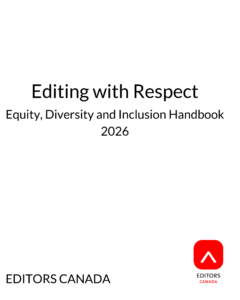
A starting point for editors interested in learning about and integrating a thoughtful approach to EDI in their work
When editors work with clients and coworkers—such as writers, proofreaders, designers and publishers—it helps to understand that words can have different meanings, and that language can affect people and groups in different ways. Just as editors improve their work by learning grammar, formatting and accessibility, they can also do better work by learning how language can either support or deny equity, diversity and inclusion.
Editors Canada created Editing with Respect to help editors make thoughtful and respectful editing choices based on current best practices, and to encourage a more equitable, diverse and inclusive culture within the association and the editing community at large.
“We’re excited to introduce this new handbook because it reflects our shared commitment to equity, diversity and inclusion in the editing profession,” says Editors Canada president, Kaitlin Littlechild.
“At its core, Editing with Respect recognizes that EDI is everyone’s responsibility, even though it affects each of us differently. Editors work with writers and communities from different backgrounds, and this resource encourages learning and taking thoughtful, informed and respectful approaches to language, research and editing practices. We hope it will help editors build confidence, deepen their understanding and make more mindful decisions in their work.”
What you’ll find in the handbook
- Why Think About EDI?
- Editors vs. Authenticity Readers
- Editing with EDI in Mind: Before the Project
- Editing with EDI in Mind: During the Project
- Recommended Practices for Inclusive Language
- Identity-First Language and People-First Language
- Characterizations in Writing
- Editing Content About Indigenous Peoples
And much more, including a robust section on resources and references.
Editors Canada will update the handbook regularly to ensure it remains aligned with language and EDI best practices as they evolve, and as new information and new sections are ready to be added.
Editing with Respect now available
Visit the Editors Canada website to start exploring Editing with Respect: Equity, Diversity and Inclusion 2026 today. The handbook is available for free in web format and as a downloadable PDF.
– 30 –
About Editors Canada
Editors Canada began in 1979 as the Freelance Editors’ Association of Canada to promote and maintain high standards of editing. In 1994, the word “Freelance” was dropped to reflect the association’s expanding focus to serve both freelance and in-house editors. As Canada’s only national editorial association, it is the hub for members and affiliates, both salaried and freelance, who work in the corporate, technical, government, not-for-profit and publishing sectors. The association’s professional development programs and services include professional certification, conferences, seminars, webinars, and networking with other associations. Editors Canada has four regional branches: British Columbia; Toronto; Ottawa–Gatineau; and Quebec, as well as smaller branches (called twigs) in Atlantic Canada, Barrie, Calgary, Edmonton, Hamilton-Halton, Kitchener-Waterloo-Guelph and Manitoba.
Media contact
Michelle Ou (she/elle)
Senior Communications Manager
Editors Canada
communications@editors.ca